Thursday, June 17, 2010

Maritime Museum

Jessie and I visited the Auckland Maritime Museum and thought of some interesting ways we could incorporate it into our class lessons.
How to use the Auckland Maritime Museum in Social Studies Classes
Maori

• Investigate the migration of people from Africa to NZ
• List the items Maori would have needed on Waka to survive on the open ocean.
• Hunt Moa (or chickens)
First Encounter

• Role play the first encounter between Maori and Capt. Cook
• Write a news paper article about the arrival of Capt. Cook
• Study the life of Capt Cook
• Design maritime uniforms
Immigration

• Compare and contrast the voyages of the Maori with the voyages of the Europeans.
• List items that a pioneer might need to establish a new homestead
• Genealogical research of family background
• Make a poster advertising immigration to NZ
• Immigrant fashion parade
Current Affairs

• Investigate the uses of whales
• The history of whaling-Greenpeace can come in and talk to class
• Inquiry into aquaculture
• Track the Whitbread Race
How to use the Auckland Maritime Museum in other curriculum subjects

Arts
  • • Sketch a ship
  • • Build a ship out of recycled materials
  • • Draw a pirate ship flag that represents your interests
  • • Design a dream bach
  • • Build a raft out of flax
  • • Scrimshaw etchings
Maths

• Measure a ship
Science

• Wind Study and how it relates to sailing
• Study constellations and navigation
Language

• Write a Journal of Immigrants daily life on a transport vessel
PE

• Play Captain is Coming
• Take a canoe trip
• Low ropes course to build teamwork
• Take the Free Ports of Auckland Cruise held every Tuesday for school groups

Wednesday, June 16, 2010

Group Work

Students must first be taught the necessary skills needed to participate in group activities. These include:
  • Sharing Skills
  • Participation Skills
  • Communication Skills
  • Listening Skills
The instructions must be clearly stated and there should be no ambiguity among the students. By giving the students clearlly defined roles this greatly decreases the misbehavior and increases learning time.  The teacher should have questions and instructions for each of the roles that the students can work on independently and then merge to share as a group. Examples of the roles are:
  • Summarizer
  • Researcher
  • Checker
  • Runner
  • Observer
  • Recorder


Possible Discussion Roles


Facilitator/Encourager: This student gets discussion moving and keeps it moving, often by asking the other group members questions, sometimes about what they've just been saying.

Timekeeper: Someone needs to make sure that the group stays on track and gets through a reasonable amount of material in the given time period.

Summarizer: Every so often (perhaps once per question for a list of questions, or at the end for one question), this student provides a summary of the discussion for other students to approve or amend.

Reflector: This student will listen to what others say and explain it back in his or her own words, asking the original speaker if the interpretation is correct.

Elaborator: This person seeks connections between the current discussion and past topics or overall course themes.
 
There are a variety of different ways in which the students can work in groups these are:
  • Thinking buddies- Allows the students to discuss what they are thinking and then report on their buddies ideas (promotes active listening)
  • Buzz Groups- For preliminary discussions.
  • Jigsaw-Where group members work on specific tasks and then come together to report findings.
  • Crossover Groups- same as jigsaw but spilt again and report to small groups.
  • Whole class- group- individual- A reversal that allows students to eventually work independently at home.
  • Snowball groups (2-4-6-8)-In which the groups gradually increase as the lesson progesses
  • Checkers- Students work independently then check each others answers and decide together on the correct answer.
I love to use group work with integrated projects were students have to research information and present it to the whole class as a poster and a presentation.

Constructivism in Practice

There are many teaching strategies that teachers use that are common elements of constructivism.
  • Connecting learns with prior knowledge
  • Modelling
  • Scaffolding
  • Coaching- Motivating and providing feedback
  • Encouraging students to articulate their ideas, thoughts, and solutions
  • Reflection 
  • Exploration and problem solving
  • Risk taking 
  • Teacher Flexibility
  • Stressing multiple realities 

Scaffolding

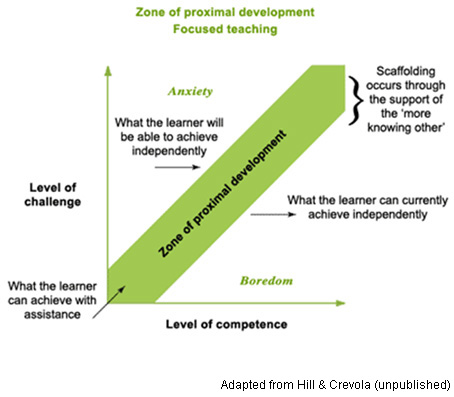
Scaffolding is used by teachers to move students beyond their current developmental stage or skill set and into progressively more difficult tasks. Scaffolding relies on sociocognitive learning where the student learns by observing a more competent person solving a problem or completing a task. The teacher provides support and models strategies for the student, then gradually withdras the support.  Scaffolding can also come from other students in the class.

Zone of Proximal Development

The zone of proximal development is the level of interest during scaffolding. Vygotsky theorized that cognitive development occurs at this point. Through scaffolding, teachers move students from the zone of proximal development to the zone of actual development, where they are able to work independently.

The provision for assisted performance is known as scaffolding. Common elements of scaffolding include:

  • Task definition
  • Direct or indirect instruction
  • Specification and sequencing of activities
  • Provision of materials, equipment and facilities
  • Other environmental contributions
  • Modeling
Scaffolding may include assistance with planning, organising, doing and/or reflecting on the specific task. Such assistance is best made available in a timely manner matched to the learning needs and interests of the learner.

As the teacher observes the students at work, he must decide when he needs to step in and model a problem-solving strategy that will pull the students forward in terms of knowledge or skills. The ideal educational environment takes into account an individual's existing skills and developmental level and provides adequate challenges for the student move forward with help and guidance--scaffolding--from the teacher.

Monday, June 14, 2010

Learning Outcomes

Learning outcomes are statements that describe significant and essential learning that learners have achieved, and can reliably demonstrate at the end of a course or program. In my opinion they are the most important aspect of the lesson planning and determine what the students should learn and how to assess this learning.  I feel the use of benchmarks is a valuable method to assess the achievement of LO. 

  • When designing learning outcomes start with what you hope children are able to achieve by the end of the unit.
  • Focus on the success criteria for the individual unit.
  • Keep learning outcomes specific and very short term.
  • Inform students what they are to achieve from the unit.  This allows students direction in thier studies and focuses their learning.
  • Keep the language of the learning outcomes simple.
  • Determine how to assess the outcomes.
  • Use the learning outcomes until they are actually acquired by the students.
Learning outcome

A learning outcome is a descriptive statement that outlines the knowledge, skill, and understanding(s) attained in an aspect of the curriculum and measured against various criteria (for example, success criteria, achievement criteria, assessment schedule, performance criteria). Learning outcomes are derived from the achievement objectives of the curriculum, and form the heart of teaching and learning plans. They are the conduit between the achievement objectives described in the curriculum and the day to day learning that happens in lessons which are expressed as learning intentions.

Teaching and learning plans should show the success criteria that guide the teacher in what they want to teach, and form the basis for assessing what the students have learnt against the learning intention. Sometimes these are called 'specific learning outcomes' (SLOs) or 'indicators' in some curriculum documents and Ministry of Education resources. (Clarke, Timperley, Hattie 2003.)

Learning outcomes are usually preceded by the stem: Students will be able to . . . (description of acquired learning).

Learning intention
Learning intentions describe the knowledge, skill, understanding(s) and/or attitudes/values that are designed to develop an aspect of the curriculum. They are usually negotiated with students and expressed in a lesson or series of lessons. Learning intentions are expressed in language that students understand and support them in understanding what they are supposed to be doing and why. Ideally students will put learning intentions into their own words.

When the learning is expressed as an intention, it implies that a process is enacted. The process involves the complex relationship between students' prior knowledge, experience, and learning capability, and the teaching and learning strategies used by the teacher to meet the individual learning needs of students. As a result of the learning process, intentions may well have to be renegotiated or transformed according to the achievements of students. Having flexible learning intentions allows for learning spontaneity and 'unplanned' learning. A learning intention takes achievement of the original learning goal into account and aims to move students on towards the next part of the learning. Students measure their success or achievement against success criteria. Once this has been attained, the learning intention becomes an outcome because it has been 'measured'.

Learning intentions are also referred to as intended learning outcomes and usually are preceded by the stem: Students will . . . (description of intended learning). They may also be written in the first person by a student: I am learning to ... (description of intended learning) and I will achieve this by... (description of criteria for achievement).

TKI.org.nz

Saturday, June 12, 2010

Star of the Day

Students love extrinsic motivation, but most of all they want to be recognized for their achievements.  A simple good job or I like the way you are working is enough to set their mood for learning for the entire day.  By selecting a Star of the Day and detailing why they were chosen is another great way to provide motivation and positively focus all the students on proper classroom behaviour.

Last day at Albany Primary


Posted by Picasa